
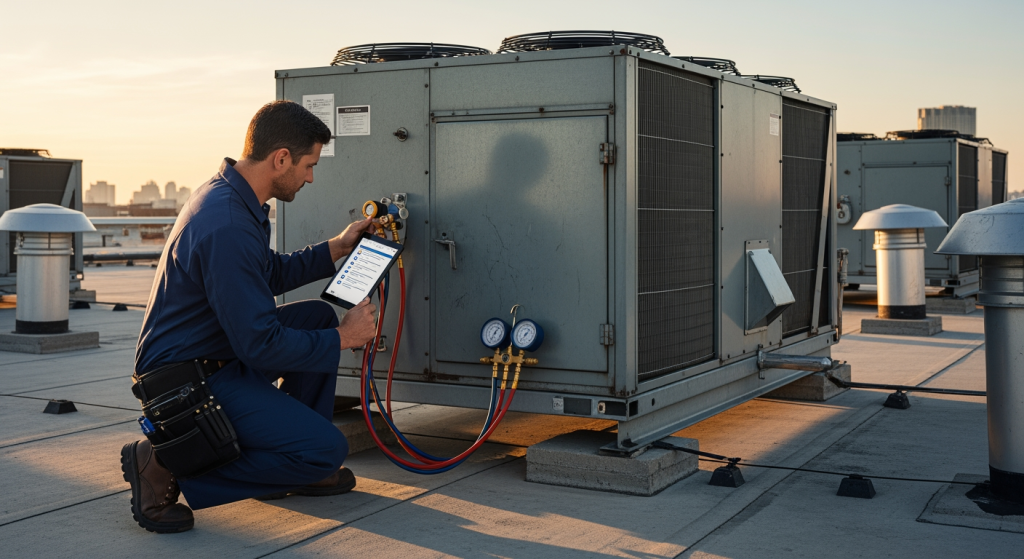
Service agreements can feel like a “nice-to-have” until your cooling or refrigeration issue starts impacting comfort, product quality, or operating hours. If you manage a facility, retail space, restaurant, healthcare site, or multi-location portfolio in Roanoke, VA, a commercial HVAC service agreement is one of the clearest ways to reduce surprise breakdowns and bring structure to maintenance. As spring transitions into warmer conditions, many teams also use this season to reset maintenance plans and confirm coverage before demand increases. The goal isn’t complexity—it’s predictability: defined scope, documented inspections, priority response expectations, and a maintenance schedule that fits your business operations.
Before you compare providers, it helps to understand what “good” looks like in a contract and how to evaluate it against your equipment, uptime needs, and compliance requirements. For deeper selection criteria, see Selecting the Right Commercial HVAC Service Provider: Criteria and Considerations.
The Essentials of a Service Agreement
- It defines planned maintenance (what gets inspected, cleaned, tested, and documented) on a set cadence.
- It clarifies what’s included vs. billable so approvals and budgeting are simpler.
- It improves response coordination by establishing processes, site rules, and points of contact in advance.
- It supports consistency across locations with standardized checklists and reporting.
- It helps reduce downtime risk by catching common wear items and control issues earlier.
What a Commercial Maintenance Agreement Typically Covers
A service agreement is a structured plan for ongoing system care. In commercial environments, that usually means scheduled visits focused on performance, reliability, and documentation. The exact scope varies by building type and equipment, but agreements commonly address comfort systems (rooftop units, split systems, make-up air), refrigeration supporting temperature-sensitive operations, and related electrical or controls checks tied to safe operation.
Most agreements are built around repeatable tasks: inspecting key components, verifying operation, cleaning where appropriate, checking filters and belts, confirming drains and airflow, and documenting findings. The point is not to “tune” equipment beyond what’s appropriate for your site—it’s to identify issues that are trending toward failure and to create a plan to correct them with minimal disruption.
The Real Business Impact of Waiting
When maintenance is reactive, small issues can become operational problems. In many commercial settings, the cost isn’t just the repair—it’s the disruption around it: uncomfortable customer areas, staff productivity loss, temperature excursions for refrigerated goods, or unplanned scheduling changes for tenants and departments.
Service agreements also affect internal workflows. Without defined scope and reporting, teams can struggle with inconsistent vendor notes, unclear recommendations, and delayed approvals. A well-defined plan helps you align facilities, operations, and finance around a shared maintenance baseline—so you can make decisions based on documented condition rather than guesswork.
Common Contract Mistakes to Avoid (Checklist)
- Assuming “full coverage” without reading exclusions — Many agreements separate planned maintenance from repairs, parts, or after-hours labor.
- Not listing equipment accurately — Missing units, wrong model info, or unverified quantities can create gaps in service and reporting.
- Vague response expectations — If priority handling matters to your operation, ensure the process is clearly defined.
- Skipping documentation requirements — Without consistent reports, it’s harder to track recurring issues, warranty needs, and capital planning.
- Overlooking site rules and access constraints — Roof access, escorts, after-hours policies, and tenant coordination should be addressed upfront.
- Choosing frequency based only on price — Too few visits can leave common wear-and-tear items unchecked for long periods.
A Practical Setup Plan for Your Agreement (Checklist)
- Build an equipment list with unit locations, model/serial numbers, and any known issues or recent repairs.
- Define your uptime priorities (customer areas, server/IT rooms, kitchens, pharmacy storage, critical care spaces) so the plan matches risk.
- Set documentation standards such as visit summaries, findings, recommended actions, and photo documentation where appropriate.
- Align maintenance timing to operations (before peak loads, during low-traffic hours, or around tenant schedules).
- Clarify approval workflows for repairs discovered during visits: who can authorize, spending thresholds, and communication channels.
- Confirm coverage scope for related systems you rely on (refrigeration, lighting, electrical, and commercial kitchen equipment) if applicable.
Professional Insight: What Most Teams Miss
In practice, we often see agreements succeed or fail based on the “handoff details,” not the equipment. When site access, contacts, escalation paths, and documentation expectations are defined early, visits run smoother, recommendations are clearer, and follow-up work gets approved faster.
When It’s Time to Bring in a Provider
Consider professional support if any of the following are true:
- You’ve had repeat comfort complaints (hot/cold spots, humidity issues, inconsistent temperatures) that keep returning.
- Your repairs feel frequent or unpredictable and you don’t have a clear maintenance baseline.
- You manage multiple sites and need consistent reporting, scheduling, and service standards across locations.
- Your operation depends on temperature control for food safety, medication storage, or customer experience.
- You’re planning equipment replacement and want condition-based insight to prioritize capital decisions.
If you’re evaluating options locally, you can review our services in Roanoke, VA to see the types of commercial systems and facilities we support.
Your Questions, Answered on Service Agreements
What’s the difference between planned maintenance and repair service?
Planned maintenance is scheduled work intended to inspect, verify operation, and address routine wear items where appropriate. Repair service is corrective work performed when something is failing or has failed. Many agreements include the maintenance visits and define how repairs are quoted, approved, and billed.
How often should a maintenance visit happen for business cooling equipment?
Frequency depends on equipment type, runtime, and the risk of downtime to your operation. Many organizations schedule multiple visits per year, then adjust based on condition findings, seasonality, and the needs of critical areas like kitchens or temperature-sensitive storage.
What information should we have ready before requesting an agreement?
It helps to have an equipment inventory (unit counts and locations), site access requirements, hours of operation, and a clear list of problem areas or recurring issues. If you have prior service records, those can also help define the initial scope.
Can one agreement cover HVAC, refrigeration, and electrical needs?
Some providers support multiple commercial systems under a coordinated maintenance approach, while others focus on a narrower scope. The key is to confirm what’s included, how documentation is handled across trades, and how dispatch and escalation work when multiple systems are involved.
How do we compare two service agreements fairly?
Compare scope (what tasks are performed), visit frequency, documentation quality, response process, exclusions, and how follow-up repairs are quoted and approved. Also compare how the provider handles multi-site consistency if you manage more than one location.
Moving Forward
A service agreement works best when it matches your equipment, your operational risks, and your internal approval process. Focus on clear scope, consistent documentation, and a maintenance cadence that supports uptime—not just a low line-item price. If you’re unsure what to include, start with your most critical areas and build from there.
Still have questions?
If you want help scoping a maintenance plan, aligning coverage to critical areas, or standardizing service across locations, a quick conversation can clarify what should be in (and out of) an agreement.
Get in Touch
Fill out our quick form and we’ll get back to you within 24 hours.