
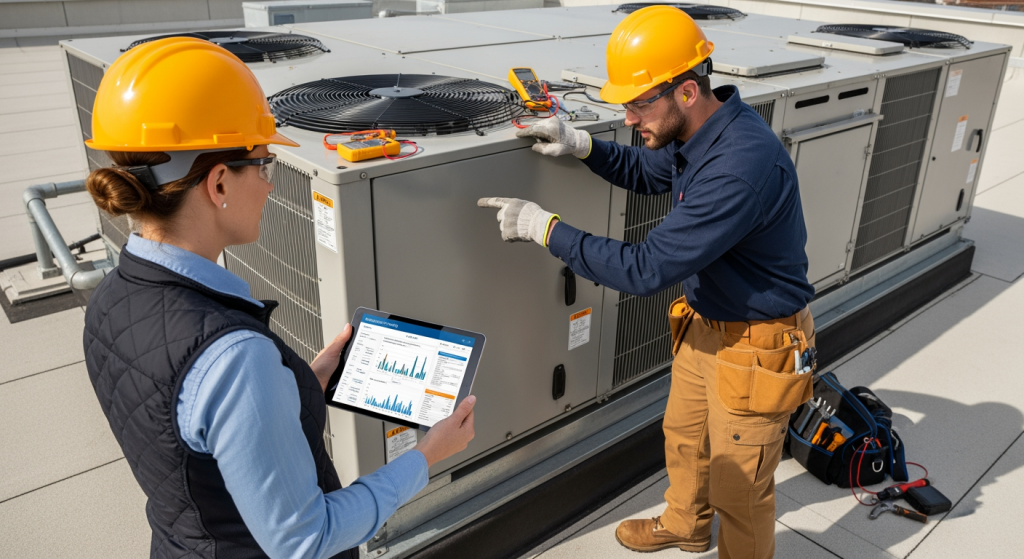
Compliance expectations for commercial HVAC systems are shifting in ways that affect day-to-day facility operations—especially for organizations juggling comfort, uptime, and budget. If you manage a retail space, healthcare facility, school, restaurant, or multi-site portfolio, it’s getting harder to separate “maintenance” from “documentation,” “efficiency,” and “risk management.” In spring, many teams also use the warming weather as a natural checkpoint to review equipment condition and service records before peak cooling demand.
What’s happening across the industry is a steady move toward clearer accountability: more emphasis on verifiable maintenance, better tracking of refrigerant-related work, and tighter expectations around electrical and life-cycle safety practices in commercial settings. This guide breaks down the trends, why they matter, and how to respond in a practical, non-alarmist way—starting with a solid foundation on evaluating commercial HVAC and refrigeration service providers.
If you’re responsible for facilities in the area, this is also where local service readiness matters. For teams looking specifically at commercial HVAC support in Bensenville, IL, the goal is to align compliance-driven requirements (records, inspections, corrective actions) with operational realities (store hours, patient care, food safety, and tenant comfort).
Bottom Line Upfront: Compliance Trends to Track
- Documentation is becoming as important as the repair. Work orders, inspection notes, and asset histories help prove consistent care and reduce disputes.
- Refrigerant work is under a brighter spotlight. Expect more attention on leak prevention, proper handling, and service recordkeeping for refrigeration and comfort cooling.
- Energy and controls are increasingly tied to “good stewardship.” Setpoints, scheduling, and equipment runtime trends can influence cost and audit readiness.
- Electrical and lighting maintenance connects to safety and uptime. Small issues (loose connections, failing drivers/ballasts) can create outsized operational disruption.
- Multi-site consistency is a compliance advantage. Standardized checklists and reporting reduce gaps between locations and vendors.
What’s Changing in Commercial HVAC Expectations (and Why)
Regulatory and industry expectations don’t usually change overnight; they tighten gradually as agencies, insurers, and corporate risk teams demand clearer proof that systems are being maintained responsibly. In practice, that often shows up as more structured service documentation, stronger emphasis on refrigerant management, and closer scrutiny of how equipment performance is monitored over time.
Another trend: the line between “comfort systems” and “mission-critical systems” is blurring. For many businesses, temperature control supports product integrity, occupant experience, and revenue continuity. That’s why more organizations are treating maintenance programs as part of governance—similar to safety inspections or food-quality programs—rather than a discretionary expense.

The Operational Risk of Falling Behind on Compliance
When compliance practices lag, the impact usually shows up in a few predictable ways: longer downtime, more last-minute approvals, and higher total disruption during equipment failures. Even when a repair is straightforward, missing documentation or unclear service history can slow decisions—especially in multi-stakeholder environments like healthcare, education, and national retail.
- Time: Delays happen when teams must recreate service history, confirm prior fixes, or validate parts and warranty status.
- Cost: Reactive work can increase after-hours labor, expedite fees, and secondary damage risk (like product loss in temperature-sensitive spaces).
- Safety and liability: Poorly tracked electrical issues, inconsistent inspections, or incomplete corrective actions can create avoidable exposure.
- Vendor friction: Disputes are more likely when “what was done” and “what was recommended” isn’t clearly recorded.
Compliance Mistakes That Create Headaches (Checklist)
- ☐ Treating documentation as optional. If notes are inconsistent, it’s hard to prove condition, recommendations, or approval decisions later.
- ☐ Mixing preventive work with “when it breaks” priorities. Skipped inspections often lead to surprise failures during high-demand periods.
- ☐ Not standardizing across locations. Different checklists and reporting formats make it difficult to compare performance and spot recurring issues.
- ☐ Ignoring controls and scheduling drift. Setpoints and schedules can slowly change, increasing runtime and complaints without an obvious “failure.”
- ☐ Letting small electrical issues linger. Minor faults can cascade into outages, nuisance trips, or equipment damage.
- ☐ Failing to close the loop on recommendations. If “monitor” and “repair soon” items aren’t tracked, they often become urgent at the worst time.
A Practical Compliance-Ready Playbook (Checklist)
- ☐ Build an asset list that matches reality. Ensure each major unit has an ID, location, and basic service history attached to it.
- ☐ Use consistent service documentation standards. Require clear problem statements, actions taken, parts used, and follow-up recommendations.
- ☐ Schedule preventive inspections around operational risk. Prioritize spaces where temperature stability protects revenue, safety, or product integrity.
- ☐ Track recurring issues, not just single events. Repeated alarms, repeat calls, or “temporary fixes” should trigger a deeper review.
- ☐ Include controls and runtime checks. Confirm scheduling, setpoints, and basic operational trends to catch drift early.
- ☐ Coordinate HVAC/R with electrical and lighting maintenance. Treat these as connected systems that influence uptime and occupant experience.
- ☐ Create a closeout process. Assign owners and due dates for recommendations so nothing disappears into the work-order void.

Professional Insight: Where Compliance Efforts Usually Break Down
In practice, we often see compliance efforts break down not because teams don’t care, but because responsibilities are split across too many people and vendors. When no one “owns” the full loop—from inspection to documentation to approval to follow-up—small issues accumulate and eventually show up as downtime, comfort complaints, or urgent replacements.
When You Should Bring in Professional Support
Consider professional help when the issue is bigger than a single repair and starts affecting risk, consistency, or operational continuity. Common thresholds include:
- Repeated failures or repeat service calls on the same units or zones
- Inconsistent maintenance records across locations, vendors, or internal teams
- Refrigeration temperature instability that threatens product integrity or food safety programs
- Electrical or lighting issues that create outages, nuisance trips, or safety concerns
- Upcoming audits, insurance reviews, or corporate inspections where documentation quality matters
Common Questions Facility Teams Ask
What does “compliance” usually mean for building comfort and refrigeration systems?
It typically means following applicable codes and regulations, keeping accurate service records, and maintaining equipment in a way that supports safe operation, reliability, and responsible refrigerant handling. Requirements vary by jurisdiction and facility type.
Do maintenance records really matter if the equipment is running fine?
Yes—records help demonstrate consistent care, support warranty and budgeting decisions, and provide context when performance changes. They also reduce confusion when personnel or vendors change.
How can multi-site businesses keep standards consistent across locations?
Use standardized inspection checklists, a consistent work-order format, and a shared reporting cadence. The goal is to make performance and risk comparable from site to site.
What should we ask a service provider to document after each visit?
At minimum: the reported issue, diagnostic findings, actions taken, parts used (if any), and clear recommendations with priority level and suggested timeline for follow-up.
Is refrigerant management only a concern for grocery and restaurants?
No. Many comfort cooling systems also rely on refrigerants. Any organization with cooling equipment can benefit from consistent leak prevention practices and clear service documentation.
Taking the Next Step Toward Compliance-Ready Operations
Industry expectations are trending toward clearer proof of responsible maintenance, better refrigerant-related recordkeeping, and more consistent cross-site standards. The practical goal isn’t perfection—it’s creating repeatable processes that reduce downtime, improve decision-making, and make audits less stressful. If you align documentation, preventive inspections, and follow-up ownership, compliance becomes a byproduct of good operations rather than a separate project.
Get in Touch
Fill out our quick form and we’ll get back to you within 24 hours.