
Replacing a commercial HVAC system is one of those facility decisions that feels simple until you’re staring at quotes, equipment options, and tenant complaints—all at the same time. If you manage a retail space, restaurant, clinic, school, or office, the goal is usually the same: restore comfort, protect temperature-sensitive operations, and avoid repeat breakdowns without overbuying capacity you’ll never use. With spring bringing warmer days and heavier cooling demand, many teams start evaluating whether another repair cycle makes sense or whether it’s time to plan a replacement.
This guide walks through how replacement decisions typically work, what information a contractor should gather, and how to prepare your site and stakeholders so the project stays predictable. For a deeper foundation on system types and decision points, see Understanding Commercial HVAC Systems: Key Concepts and Considerations.
If you’re coordinating commercial HVAC replacement in Indianapolis, IN, it helps to approach the project like a controlled changeover: define the business risk, confirm the load and ventilation needs, align on scheduling constraints, and document what “done” looks like before equipment is ordered.
The Essentials for a Smart Replacement
- Replacement is usually justified by risk, not age alone: repeated failures, long lead times on parts, comfort complaints, or operational impact often matter more than the nameplate year.
- Right-sizing is critical: equipment that’s too large can short-cycle; too small can struggle during peak loads—either way, you pay for it in comfort and operating costs.
- Scope clarity prevents surprises: confirm what’s included (unit, curb/adapter, controls, electrical, crane, permits, start-up, disposal, commissioning expectations).
- Scheduling is a business decision: plan around occupancy, food safety needs, hours of operation, and any tenant or customer experience constraints.
- Documentation matters: submittals, warranty terms, service access, and control sequences should be understandable to the people who will run the building after install.
How Commercial System Replacement Typically Works
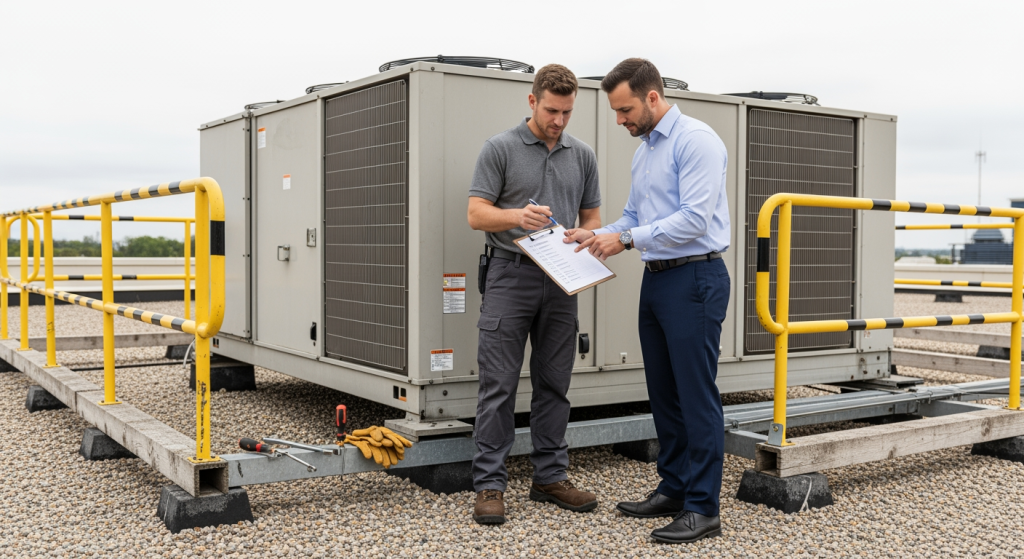
A replacement project is more than swapping a box on the roof. In most facilities, the contractor needs to confirm what the existing system serves, how air is distributed, and what constraints the building creates (roof access, structural considerations, electrical capacity, and control wiring). A practical replacement process often includes:
- Site assessment: documenting current equipment, capacity, condition, and service history; identifying comfort problem areas and any recurring faults.
- Load and usage review: understanding occupancy patterns, operating hours, equipment heat loads (kitchens, IT rooms), and ventilation requirements.
- Equipment selection: choosing a suitable system type and efficiency tier that fits the building’s needs and budget constraints.
- Controls and integration planning: confirming thermostat zoning, building automation interfaces (if present), and any sensor requirements.
- Installation plan: determining crane/logistics, shutdown windows, safety planning, and how to keep critical areas stable during changeover.
- Start-up and verification: confirming airflow, refrigerant charge (as applicable), control sequences, and basic performance checks.
For multi-site businesses, standardizing equipment families, filters, and control approaches can also reduce training time and simplify parts stocking—especially when multiple locations share similar footprints.

The Real-World Costs of Waiting Too Long
Delaying replacement can be reasonable when reliability is still acceptable—but it becomes expensive when downtime affects operations. The impacts usually show up in a few predictable places:
- Business interruption: uncomfortable spaces can reduce productivity, shorten dwell time for customers, and create tenant friction.
- Protection of temperature-sensitive areas: certain operations (pharmacies, clinics, prepared foods, server rooms) may have tighter tolerance for temperature swings.
- Compounding repair cycles: repeated service calls often bring hidden costs: staff time, after-hours coordination, and recurring parts failures.
- Longer restoration timelines: if a major component fails, lead times and access constraints can extend downtime compared to a planned changeout.
- Budget volatility: unplanned replacements tend to compress decision timelines, which can limit options for scheduling and scope optimization.
Even when a system can be repaired, many teams choose replacement when the operational risk of another failure becomes unacceptable for the site’s mission.
Common Replacement Mistakes to Avoid (Checklist)
- ☐ Choosing size based on the old unit only: building use changes, remodels, and occupancy shifts can make the old capacity a poor reference point.
- ☐ Ignoring distribution problems: replacing the unit won’t fix blocked returns, damaged ductwork, or poor zoning that causes hot/cold complaints.
- ☐ Under-scoping controls work: mismatched thermostats, sensors, or sequences can create comfort issues that look like “bad equipment.”
- ☐ Not confirming electrical and roof constraints early: disconnects, breakers, roof curbs, and access paths can change cost and timeline.
- ☐ Treating “efficiency” as a single number: real savings depend on runtime, setpoints, maintenance, and correct setup—not just the equipment label.
- ☐ Skipping a clear acceptance checklist: without agreed handoff criteria, you may inherit unresolved airflow or control issues.
A Practical Replacement Plan You Can Use
- ☐ Document current pain points: list comfort complaints, shutdown incidents, and spaces with special temperature needs.
- ☐ Gather system basics: equipment model/serial, tonnage/capacity, service history, filter sizes, thermostat/zoning map, and operating schedule.
- ☐ Define business constraints: acceptable downtime windows, noise restrictions for occupied areas, and any food/medication protection requirements.
- ☐ Request a scope that’s apples-to-apples: ensure each proposal states included labor, rigging/crane, controls, electrical, permits (where required), start-up, and disposal.
- ☐ Ask how right-sizing is being confirmed: request a plain-language explanation of what inputs were used (building use, hours, ventilation, problem areas).
- ☐ Plan the changeover day: identify who approves shutdown, who has roof access authority, and who communicates with tenants/staff.
- ☐ Set handoff expectations: confirm what documentation you’ll receive (warranty info, submittals, control sequences, maintenance recommendations).
- ☐ Put maintenance on the calendar: align filter changes, coil cleaning, and inspections with your operating realities to protect the new investment.
Professional Insight: What Most Teams Miss
In practice, we often see replacement projects go sideways not because the equipment is wrong, but because the operational requirements weren’t written down—things like “this space can’t be down during business hours,” “this area must stay stable for product,” or “the staff needs simple controls.” When those constraints are clarified early, equipment selection and scheduling tend to become much more straightforward.
When to Bring in a Commercial HVAC Pro
Some planning can happen internally, but replacement decisions move faster when you involve a qualified commercial provider once any of these are true:
- Recurring breakdowns are affecting operations: especially if the same faults repeat or comfort complaints are escalating.
- Critical areas can’t tolerate temperature swings: healthcare spaces, food service, pharmacy, or other temperature-sensitive environments.
- You’re considering a change in use: remodels, added equipment loads, extended hours, or occupancy changes that may alter capacity needs.
- Controls are inconsistent or confusing: zones fighting each other, frequent overrides, or unclear scheduling behavior.
- Access and logistics are complex: rooftop units requiring crane planning, limited roof access, or tight shutdown windows.
Frequently Asked Questions
How do I know if replacement is better than another repair?
Consider replacement when reliability risk becomes the main issue—frequent service calls, repeated failures, or downtime that disrupts operations. A provider can help compare near-term repair paths versus a planned changeout with clearer scheduling and scope.
What information should I have ready before requesting a quote?
Helpful items include equipment model/serial numbers, current capacity, known comfort issues, operating hours, access constraints, and any special requirements (like temperature-sensitive areas). Photos of the unit and mechanical space can also speed up early discussions.
Will a new unit automatically fix hot and cold spots?
Not always. Uneven comfort can come from airflow balance, zoning, duct issues, or control sequences. A good replacement plan should identify whether distribution or controls work is needed alongside the new equipment.
What should be clearly stated in the replacement scope?
At minimum, confirm what’s included for rigging/crane, electrical work, controls/thermostats, permits (where applicable), curb/adapter needs, start-up, disposal of old equipment, and what documentation you’ll receive at handoff.
How can multi-site businesses make replacements more manageable?
Standardizing equipment families, filter sizes, and control approaches can simplify training and reduce variability. It also helps to keep a consistent replacement checklist so each site follows the same decision and handoff process.
Where to Go from Here
A commercial system replacement is easiest when you treat it like a planned operations project: define constraints, confirm sizing and controls, and insist on a clear scope and handoff. If you’re weighing repair versus replacement, start by documenting the business impact of downtime and the comfort problems you’re trying to solve. Then align proposals around comparable scope so you can make a confident decision. Done well, replacement becomes a controlled upgrade—not a scramble.
Learn More About Our Services
Discover how we can help you achieve your goals.