
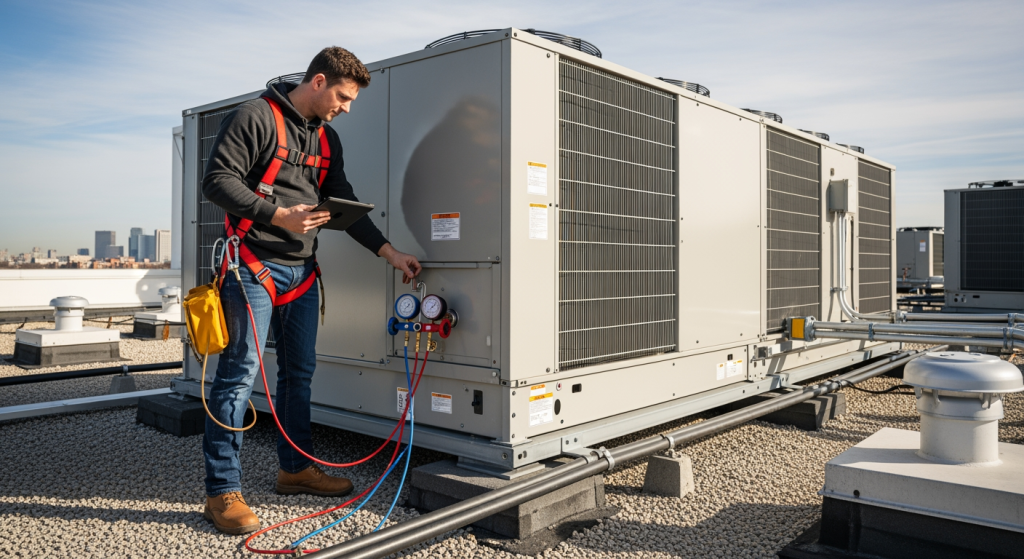
Running a business means you rarely get to choose when heating and cooling problems show up—yet comfort, uptime, and temperature-sensitive operations often depend on them. If you’re a facility manager, operations leader, or multi-site owner trying to understand how commercial HVAC service operations work, the goal is simple: reduce disruption while keeping systems reliable and compliant with your internal standards. As spring transitions into warmer conditions, many teams also use this period to reset maintenance plans and confirm vendor readiness before peak demand.
Service operations is more than “sending a tech.” It’s the coordinated process behind intake, dispatch, diagnostics, parts, documentation, and follow-up—especially important for restaurants, retail, healthcare clinics, and other commercial facilities where downtime can impact staff productivity, customer experience, and product integrity. For a deeper primer on how these systems are structured, see Understanding Commercial HVAC Systems.
If you’re evaluating commercial HVAC service operations in Melbourne, FL, it helps to know what “good operations” look like on the ground—what gets tracked, what gets prioritized, and what information you should have ready when something goes wrong.
What You Need to Know First About Service Operations
- Service operations is the end-to-end workflow for handling commercial heating/cooling issues—from call intake to closeout documentation.
- Better operations usually mean clearer communication, faster triage, and fewer repeat visits—not just faster dispatch.
- Most delays come from missing site details (access, unit identification, tenant schedules) or parts availability.
- A planned maintenance approach can reduce surprise breakdowns by catching issues early and standardizing inspections.
- You’ll get better outcomes when you can share asset lists, recent service history, and the business impact of downtime.
How Commercial HVAC Service Operations Actually Run
Commercial service operations is the system behind consistent outcomes. While every provider’s workflow differs, most professional operations follow a similar path:
1) Intake and triage. Your request is logged with key details (site, symptoms, hours, access, and any safety or food/medication storage concerns). Triage helps determine whether the situation is a comfort issue, a temperature-control risk, or a broader electrical/controls problem.
2) Dispatch and routing. The provider assigns a technician with the right skill set and tools for the equipment type. For multi-site organizations, dispatch may also coordinate with your internal ticketing process or store-level contacts.
3) On-site diagnostics. The technician verifies the issue, checks likely failure points, and determines whether the fix is immediate or requires parts, approvals, or a return visit. Diagnostics in commercial settings often involve rooftop units, split systems, controls, and airflow distribution—not just a single piece of equipment.
4) Repair, stabilization, or escalation. Some calls end with a repair. Others require temporary stabilization (keeping spaces safe/usable) while parts are sourced or a larger scope is quoted.
5) Documentation and closeout. You should receive service notes that support accountability: what was found, what was done, what parts were used (if any), and what risks or recommendations remain.

The Real Operational Impact of Delays and Repeat Visits
When service operations break down, the effects often show up in places beyond the mechanical room:
- Downtime and lost productivity: Uncomfortable spaces can reduce staff performance and disrupt customer flow.
- Risk to temperature-sensitive areas: Some businesses rely on stable indoor conditions to protect inventory, equipment, or patient comfort.
- Budget surprises: Reactive work can lead to more after-hours labor, expedited parts shipping, or repeated diagnostics.
- Inconsistent site experience: Multi-location brands can struggle when one site gets different outcomes than another due to uneven documentation or varying on-site contacts.
- Shortened equipment life: Ongoing operation with airflow restrictions, low refrigerant charge, or control issues can increase wear and accelerate replacement timelines.
Common Missteps That Disrupt Commercial Service (Checklist)
- ☐ Reporting symptoms without context: “Not cooling” is a start, but include affected zones, when it began, and any recent changes (renovations, new hours, new equipment).
- ☐ No clear unit identification: If there are multiple rooftop units or split systems, label consistency matters. Confusion can waste hours.
- ☐ Access assumptions: Roof hatches, locked electrical rooms, and tenant coordination can delay work if not arranged in advance.
- ☐ Skipping documentation review: Ignoring prior service notes can cause repeat diagnostics and missed patterns.
- ☐ Treating maintenance as optional: Without planned inspections, small issues often become peak-season failures.
- ☐ Mixing responsibilities: If HVAC, refrigeration, lighting, and electrical issues overlap, unclear ownership can stall resolution and approvals.
A Practical Prep List for Smoother Service Calls (Checklist)
- ☐ Maintain an up-to-date asset list: Include equipment type, location (roof/zone), model/serial, and any internal naming conventions.
- ☐ Standardize site contact info: Provide primary/backup contacts and preferred communication methods for each location.
- ☐ Define business impact: Note if the issue affects customer areas, staff-only spaces, temperature-sensitive rooms, or critical operations.
- ☐ Prepare access instructions: Roof entry, keys, codes, escort requirements, and any restricted hours.
- ☐ Centralize service history: Keep recent work orders and recurring issue notes available for faster diagnostics.
- ☐ Align on approval steps: Clarify who can approve parts, additional labor, or follow-up visits—especially for multi-site organizations.

Professional Insight: What Most First-Time Callers Miss
In practice, we often see that the fastest path to a stable fix isn’t just rapid dispatch—it’s accurate information at intake and consistent site standards (labels, access, contacts, and service history). When those basics are in place, technicians spend less time searching and more time diagnosing and resolving the real issue.
Signs It’s Time to Bring in a Commercial HVAC Team
Consider professional support when you notice any of the following:
- Recurring comfort complaints in the same zones, even after prior service.
- Unexpected shutdowns or systems that cycle on/off frequently.
- Temperature instability that affects operations, sensitive inventory, or customer-facing spaces.
- Multiple systems involved (controls, electrical, airflow) where the root cause isn’t obvious.
- Multi-site consistency needs where standardized documentation, reporting, and scheduling matter.
- Planning for replacement and you need help comparing repair vs. replace options based on condition and operational risk.
Common Questions Answered
What does “service operations” mean in a commercial setting?
It refers to the coordinated workflow that turns a problem report into a documented outcome—intake, dispatch, diagnostics, repair planning, parts coordination, and closeout notes.
How is commercial heating and cooling different from residential work?
Commercial systems often serve larger spaces, multiple zones, and longer operating hours, and they may involve rooftop equipment, controls, and more complex access and scheduling requirements.
What information should I have ready before I place a service request?
Have the site address, on-site contact, access instructions, affected areas, when the issue started, and any recent service history or recurring patterns.
Is planned maintenance only for large multi-location organizations?
No. Many single-site businesses use planned inspections to reduce unplanned downtime and to standardize what gets checked, documented, and addressed before issues escalate.
What is a self-performing contractor?
It’s a provider that uses its own technicians to complete work rather than outsourcing most calls to third parties. For some organizations, that can simplify communication and standardize service outcomes.
Where to Go from Here
Commercial service operations works best when the provider and the customer share clear expectations: what gets prioritized, how sites are prepared, and how outcomes are documented. If you’re new to managing building systems, focus on the fundamentals—asset visibility, consistent access, and a repeatable process for reporting issues. Over time, planned maintenance and better documentation can reduce repeat calls and improve reliability. When you’re ready, compare providers based on communication, documentation quality, and their ability to support your type of facility.
Learn More About Our Services
Discover how we can help you achieve your goals.