
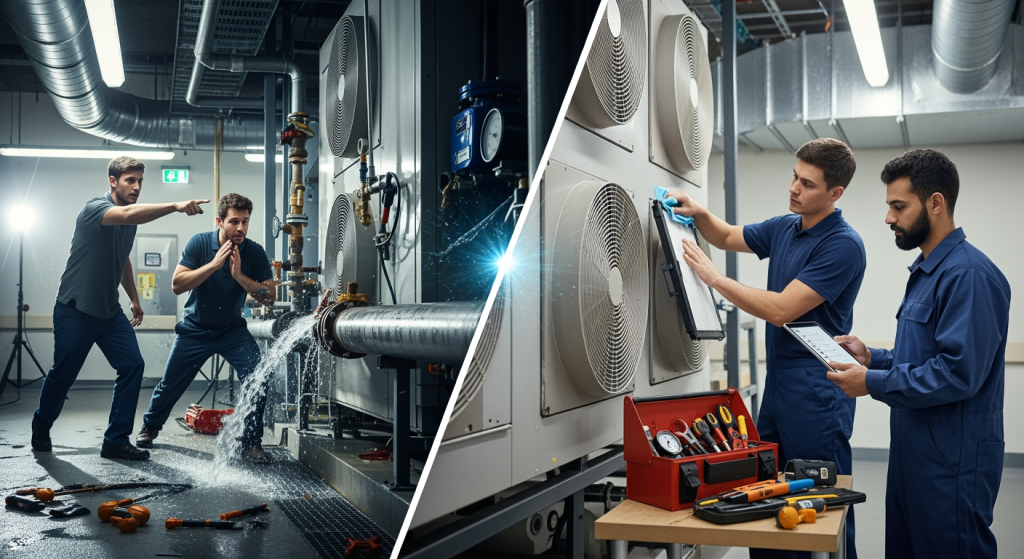
Facility leaders and operations teams often face the same decision after a breakdown: should you rely on emergency commercial HVAC service vs maintenance planning to protect uptime? For commercial buildings, restaurants, retailers, and healthcare or education sites, the answer affects comfort, product integrity, and day-to-day continuity—not just the repair bill. In the winter months, that pressure can increase because heating performance and indoor comfort issues show up fast. This comparison breaks down how emergency response and planned maintenance differ, what each option is best for, and how to choose a balanced approach for your portfolio in the Houston area (Conroe, TX).
Before comparing options, it helps to align on what a “commercial” system typically includes (controls, rooftop units, split systems, ventilation, and related electrical components). For a plain-language overview, see Understanding Commercial HVAC Systems.
The Essentials: Emergency Response vs. Maintenance in One View
- Emergency service is designed to restore operation quickly when a system failure disrupts your business; it prioritizes triage and stabilization.
- Planned maintenance focuses on reducing avoidable failures, improving predictability, and extending equipment life through scheduled inspections and tune-ups.
- Cost profiles differ: emergency work can carry higher total cost due to after-hours logistics, expedited parts, and secondary damage risk; maintenance is typically budgetable and spread over time.
- Uptime strategy is usually “both”: maintenance reduces incidents, while emergency readiness covers the failures you can’t fully prevent.
- Best choice depends on risk tolerance: sites with food, pharmaceuticals, or strict comfort requirements generally benefit from more proactive coverage.
Breaking Down the Options: What You’re Actually Buying
Emergency commercial HVAC service is a reactive model: a problem occurs, you call, and the provider dispatches a technician to diagnose, restore function, and recommend next steps. The immediate goal is getting the site operational again—sometimes with a temporary fix until parts or a larger repair can be completed.
Planned maintenance is proactive: you schedule recurring visits to inspect, test, clean, and adjust key components. The goal is to catch wear, airflow issues, control problems, refrigerant-related concerns, and electrical or mechanical stressors before they become a shutdown. Maintenance often includes documentation, recommendations, and lifecycle planning so replacements can be scheduled rather than forced.
| Comparison criteria | Emergency service | Planned maintenance |
|---|---|---|
| Primary goal | Restore operation fast | Reduce failures and improve predictability |
| Typical trigger | System down, no heat/cooling, alarms, major comfort complaint | Calendar-based schedule, runtime-based schedule, or seasonal readiness |
| Work style | Triage → diagnose → stabilize → repair/plan follow-up | Inspect → test → clean/adjust → document → plan improvements |
| Budgeting | Variable and harder to predict | More predictable and easier to forecast |
| Impact on uptime | Can restore quickly, but doesn’t prevent recurrence by itself | Reduces unplanned downtime frequency and severity |
| Best fit | Unexpected failures, critical outages, “keep us open” moments | Multi-site consistency, compliance-minded operations, lifecycle planning |

The Real Cost of Waiting: Risk, Downtime, and Secondary Damage
The biggest difference between reactive and proactive approaches is how risk shows up in your operations. Emergency calls often happen at the worst time—during peak business hours, during extreme indoor comfort complaints, or when temperature-sensitive areas are already drifting out of range.
- Downtime costs can exceed the repair cost: lost sales, disrupted services, or operational slowdowns can add up quickly, especially for customer-facing sites.
- Secondary damage becomes more likely: a small issue (like restricted airflow or a failing capacitor) can cascade into compressor stress, motor failure, or control faults if it runs too long.
- Parts and scheduling constraints: when a system is already down, you may have fewer options—expedited shipping, substitutions, or temporary measures.
- Comfort and brand impact: recurring hot/cold calls can affect tenant satisfaction, shopper experience, and staff productivity.
Planned maintenance doesn’t eliminate failures, but it can reduce the chance that a minor defect becomes a full outage. It also tends to produce better information: condition notes, trend observations, and clearer replacement timing.
Common Missteps That Make Both Options More Expensive (Checklist)
- ☐ Treating emergency response as a “strategy”: if you only act when units fail, you may see repeated calls on the same assets and more disruptive breakdowns.
- ☐ Skipping documentation: without service history, recurring issues are harder to diagnose and you lose leverage in replacement planning.
- ☐ Not defining what “critical” means: sites with food storage, pharmacies, or high-occupancy spaces often need a different response plan than low-risk areas.
- ☐ Assuming all maintenance is the same: a checklist without testing, measurements, and follow-through may not reduce downtime meaningfully.
- ☐ Ignoring controls and electrical contributors: comfort complaints can stem from sensors, scheduling, relays, or power quality—not only mechanical components.
- ☐ Delaying replacement decisions: repeatedly repairing end-of-life equipment can create a cycle of unpredictable outages and rushed spending.

A Practical Decision Framework for Facility Managers (Checklist)
- ☐ Classify each site by criticality: identify locations where temperature, ventilation, or humidity directly impacts product integrity, patient care, or customer experience.
- ☐ Inventory your equipment and known pain points: capture unit types, approximate age, recurring issues, and any comfort “hot spots.”
- ☐ Set uptime targets by space type: define what “acceptable disruption” looks like for offices vs. retail floors vs. kitchens vs. refrigerated areas.
- ☐ Build a maintenance cadence that matches runtime: higher-use sites typically need more frequent attention than lightly used spaces.
- ☐ Establish an escalation path: decide who approves after-hours work, temporary measures, or replacements when a failure occurs.
- ☐ Use service data to plan replacements: when repairs become repetitive, compare total cost and business disruption against a scheduled replacement window.
Professional Insight: Where the “Best Value” Usually Shows Up
In practice, we often see the best outcomes when businesses combine planned maintenance with clear emergency readiness—especially across multi-site portfolios—because it reduces surprise outages while still protecting you when unpredictable failures happen. The key is consistency: the same inspection standards, documentation, and decision rules across locations so you’re not reinventing the process every time a unit goes down.
When It’s Time to Bring in Commercial Support
- Repeated comfort complaints (hot/cold zones, humidity issues, or frequent resets) that keep returning after basic adjustments.
- Any loss of heating or cooling capacity that affects occupancy, customer areas, or temperature-sensitive operations.
- Unusual noises, odors, or short-cycling that suggest mechanical or electrical stress.
- Controls or scheduling problems that cause systems to run at the wrong times or fail to maintain setpoints.
- Evidence of recurring repairs on the same unit or component—often a sign you need a deeper root-cause review or replacement planning.
- Portfolio standardization needs when you want consistent maintenance and response expectations across multiple locations, including surrounding metro coverage.
Common Questions Answered
Is planned service still useful if we already have after-hours response available?
Yes. After-hours response helps you recover from failures, while scheduled upkeep is aimed at reducing how often those failures occur and improving predictability for budgeting and operations.
How do we decide which locations need more proactive coverage?
Start with business impact: sites with high occupancy, strict comfort requirements, or temperature-sensitive goods typically warrant a tighter inspection cadence and clearer escalation rules.
What should we document after a major breakdown?
Capture the symptom, diagnosis, parts replaced, any temporary measures, and recommendations for follow-up. Keeping consistent records across sites makes recurring issues easier to spot and reduces repeated troubleshooting.
Does maintenance eliminate unplanned downtime?
No. It can reduce frequency and severity, but equipment can still fail unexpectedly. That’s why many organizations pair routine upkeep with a defined response plan for critical outages.
What’s a reasonable way to compare value between reactive repairs and a maintenance plan?
Compare more than invoices: include disruption time, repeat-call frequency, any product loss or operational impact, and whether you’re forced into rushed replacement decisions versus planned capital timing.
Your Next Steps
Emergency response and planned maintenance solve different problems: one restores operation when you’re down, the other reduces the chances you’ll go down in the first place. For most commercial operators, the strongest approach is a maintenance program sized to site criticality, paired with a clear plan for after-hours failures. If you manage multiple locations, consistency in documentation and decision-making can be as valuable as the wrench work. When you’re ready, align your internal stakeholders on uptime targets and build a service approach that matches them.
Get Your Free Quote
Find out how we can help with a no-obligation quote.