
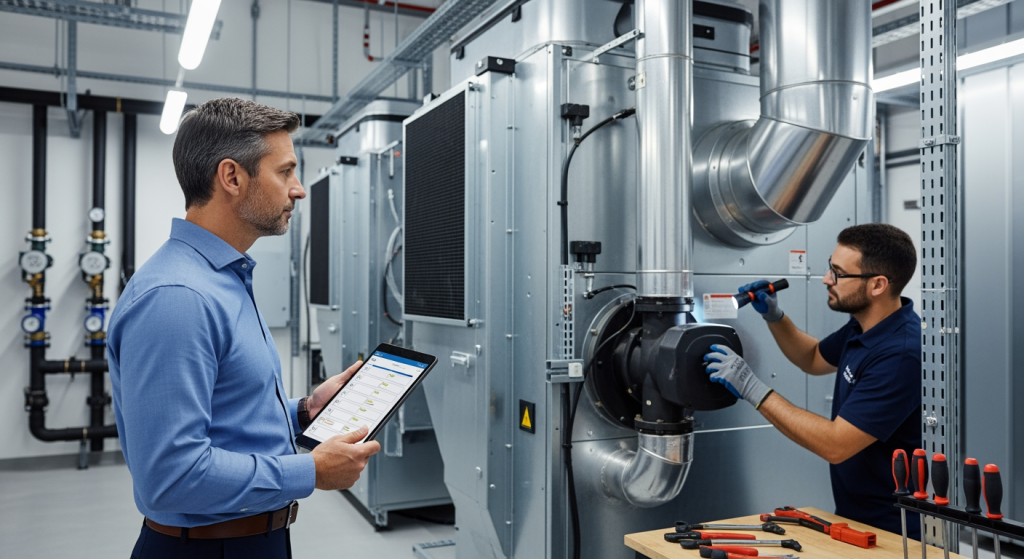
Facility managers often hit a critical window in late winter: your building has been running hard for months, and small HVAC issues can quietly stack up into comfort complaints, downtime, or avoidable repair spend. This commercial HVAC preventive maintenance checklist is designed for commercial facilities teams who need a practical, repeatable way to verify system readiness, document conditions, and reduce surprises before seasonal demand shifts. If you manage multiple rooftops, split systems, or mixed-use zones, a structured walkthrough also helps you communicate clearly with stakeholders and service partners. For a broader baseline on components and terminology, see Understanding Commercial HVAC Systems.
In the Denver, CO metro, late-winter planning can be especially helpful because equipment may be cycling between heating and ventilation needs depending on occupancy and building schedules.
Bottom Line Upfront: Late-Winter PM Essentials
- Prioritize safety and documentation first. Lockout/tagout, capture model/serial, and record current setpoints and alarms before changes.
- Focus on airflow basics. Filters, belts, dampers, and coils drive comfort and energy use more than many “advanced” tweaks.
- Verify heating performance and controls. Confirm staging, safeties, and sensor accuracy to avoid nuisance trips.
- Check drainage and moisture management. Drain pans, traps, and slopes prevent leaks, odors, and IAQ issues.
- Confirm electrical integrity. Loose terminations and failing contactors can cause intermittent faults and shutdowns.
- Turn findings into a plan. Assign owners, rank urgency, and schedule follow-ups for anything outside normal ranges.
How a Late-Winter Preventive Maintenance Review Works in Commercial Buildings
A late-winter maintenance review is a structured inspection and verification process focused on three outcomes: (1) keep heating reliable through the tail end of the season, (2) reduce wear from months of runtime, and (3) identify issues that could become failures when schedules, ventilation rates, or loads change. For most commercial systems, that means confirming airflow and heat transfer, validating control sequences, and checking electrical and mechanical components for early signs of failure.
Unlike residential checklists, commercial PM typically requires documentation across multiple units, coordination with building access rules, and attention to how zones interact (e.g., one rooftop unit’s outside air settings affecting adjacent spaces). The goal isn’t to “tune” a system with guesswork—it’s to verify condition, correct known wear items, and document exceptions for planned repair.

The Real Business Impact of Skipping Late-Winter PM
When preventive maintenance is deferred, the first signs are often operational: hot/cold calls, uneven airflow, longer warm-up times, and rising energy use. Over time, minor issues can become failures that disrupt occupants, tenants, or customers.
- Downtime risk: A single failed component (belt, contactor, igniter, sensor) can take a unit offline and strain remaining equipment.
- Budget volatility: Reactive repairs tend to be harder to schedule and can trigger premium labor, expedited parts, or after-hours work.
- Comfort and productivity: Temperature swings and poor ventilation can increase complaints and distract staff.
- Asset life: Chronic airflow restriction, dirty coils, and short cycling can accelerate wear and reduce equipment lifespan.
- Compliance and reporting: Incomplete logs make it harder to demonstrate responsible maintenance to internal stakeholders.
Common Missteps That Undermine Preventive Maintenance (Checklist)
- ✓ Skipping trend review and going straight to “fixing.” If you don’t capture current alarms, runtimes, and setpoints first, you lose the baseline needed for accurate comparisons.
- ✓ Treating filter changes as the whole program. Filters matter, but belts, dampers, coils, and sensors often drive recurring comfort issues.
- ✓ Not confirming economizer/damper movement. Dampers that stick or actuators that drift can create IAQ and temperature control problems.
- ✓ Ignoring condensate drains in cold months. Drain issues don’t wait for summer; they can cause leaks and microbial growth conditions year-round.
- ✓ Failing to document “as found” vs. “as left.” Without clear notes, recurring issues look like new problems and slow down troubleshooting later.
- ✓ Letting minor electrical issues linger. Loose connections and worn contactors can present as intermittent faults that are difficult to reproduce.
Your High-Priority Commercial HVAC Preventive Maintenance Checklist (Late Winter)
Priority key: (P1) Do now to reduce near-term failure risk • (P2) Schedule soon • (P3) Plan/monitor
- ✓ (P1) Confirm safe access and lockout/tagout readiness. Verify roof access procedures, unit disconnects, and required PPE before panels come off.
- ✓ (P1) Capture equipment inventory and condition notes. Record unit IDs, model/serial, visible corrosion, missing panels, unusual noise/vibration, and any standing water.
- ✓ (P1) Check filters and verify correct fit and loading. Replace per site standard, confirm bypass gaps aren’t allowing unfiltered air, and note abnormal dirt patterns that may indicate return leaks.
- ✓ (P1) Inspect belts, pulleys, and sheaves (where applicable). Look for glazing, cracking, misalignment, and tension issues that can reduce airflow and increase motor load.
- ✓ (P1) Verify supply/return fan operation. Confirm fans start/stop as commanded and listen for bearing noise or rubbing that suggests mechanical wear.
- ✓ (P1) Inspect coils for blockage and damage. Note matted debris, bent fins, or signs of restricted airflow that can reduce heat transfer and drive longer runtimes.
- ✓ (P1) Confirm damper/economizer movement and linkage condition. Verify actuators respond to commands and dampers open/close smoothly without binding.
- ✓ (P1) Validate heating sequence and safeties. Observe call-for-heat response, staging, and safety behavior (e.g., limit switches). Document any lockouts or nuisance trips for follow-up.
- ✓ (P1) Check gas/combustion-related components for visible issues (where applicable). Look for soot, discoloration, or damaged wiring/ignition components and escalate to qualified service if anything appears abnormal.
- ✓ (P1) Inspect condensate pan, drain, and trap condition. Confirm proper slope, no standing water, and no signs of leakage or overflow history.
- ✓ (P2) Verify thermostat/sensor placement and basic accuracy. Note sensors exposed to drafts, direct sun, or heat sources; document discrepancies between displayed and measured readings if your site procedure allows.
- ✓ (P2) Review control settings and schedules with stakeholders. Confirm occupancy schedules, setbacks, and ventilation expectations align with actual building use.
- ✓ (P2) Inspect electrical panels and terminations for heat or wear indicators. Look for discoloration, brittle insulation, or loose components; document and schedule corrective work.
- ✓ (P2) Check contactors, relays, and capacitors for wear signs. Pitting, buzzing, or intermittent operation should be logged for planned replacement.
- ✓ (P2) Confirm clearances and housekeeping around equipment. Remove stored items near indoor units and confirm rooftop units have appropriate service clearance per site policy.
- ✓ (P3) Compare current performance to prior service notes. Track recurring zones, repeated part replacements, or persistent alarms to identify root-cause candidates.
- ✓ (P3) Build a spring transition list. Identify units likely to need coil cleaning, damper repair, sensor replacement, or controls review before warmer-weather loads increase.
Downloadable summary (copy/paste):
- ✓ Safety + access verified
- ✓ Inventory + “as found” notes captured
- ✓ Filters, belts, fans, coils checked
- ✓ Dampers/economizer verified
- ✓ Heating sequence + safeties observed
- ✓ Condensate management inspected
- ✓ Sensors/schedules reviewed
- ✓ Electrical wear indicators documented
- ✓ Follow-up plan created with priorities
Professional Insight: The Small Notes That Prevent Repeat Failures
In practice, we often see the biggest maintenance wins come from consistent documentation—especially writing down what looked “slightly off” even when a unit is still running. Those small notes (intermittent noise, minor vibration, a damper that hesitates, a recurring alarm that clears) are often what helps a facility team plan a controlled repair instead of reacting to a shutdown later.
When to Bring in Commercial HVAC Support
- ✓ Repeated lockouts, trips, or alarms. If the same unit fails more than once, it’s a sign the underlying cause hasn’t been addressed.
- ✓ Burning smells, electrical discoloration, or visible arcing signs. These should be evaluated by qualified professionals due to safety and equipment-risk concerns.
- ✓ Unusual combustion indicators on gas heat. Soot, persistent odor, or abnormal flame behavior warrants professional assessment.
- ✓ Persistent comfort complaints in the same zones. Recurring hot/cold calls often point to airflow balance, damper/control issues, or sensor placement problems.
- ✓ Water where it shouldn’t be. Active leaks, repeated drain pan overflow evidence, or ceiling stains should be investigated promptly to limit building damage.
- ✓ Multi-site consistency needs. If you manage multiple locations and need standardized reporting, escalation paths, and planned maintenance coordination.
Frequently Asked Questions for Facility Teams
What should a facility manager document during a maintenance walkthrough?
Capture unit IDs, model/serial, current setpoints and schedules, active alarms, “as found/as left” notes, and any parts or conditions needing follow-up. Photos can help when your site process allows.
How is preventive maintenance different for commercial equipment compared to residential?
Commercial programs typically involve multiple units, zone interactions, controls/scheduling complexity, and formal documentation for stakeholders. The work is often coordinated to reduce disruption to occupants and operations.
Which components most often affect comfort complaints?
Airflow-related items are common drivers: filters, belts, fan performance, dampers, and coil condition. Sensor placement and scheduling issues can also create “it never feels right” complaints.
Is it normal for some zones to feel different even when the system is operating?
It can happen due to occupancy patterns, solar gain, door traffic, or ventilation requirements. If the same areas consistently run too hot or too cold, document the pattern and have the system evaluated for airflow, damper, or controls issues.
What does “24 hour emergency readiness” mean in a commercial service context?
It generally refers to having after-hours processes and on-call capabilities to respond to urgent equipment failures at commercial facilities. Specific response expectations and coverage are typically defined by your service agreement.
Taking Action Before the Next Demand Shift
A late-winter walkthrough is one of the simplest ways to reduce surprises: verify airflow, confirm heating and controls behavior, inspect condensate management, and document electrical and mechanical wear. Use the checklist to standardize what your team looks for, then convert findings into a prioritized plan with clear owners and timelines. Consistent notes and follow-through are what turn PM from a task into a reliability program.
Want More Information?
Download our free resource to learn more about this topic.