
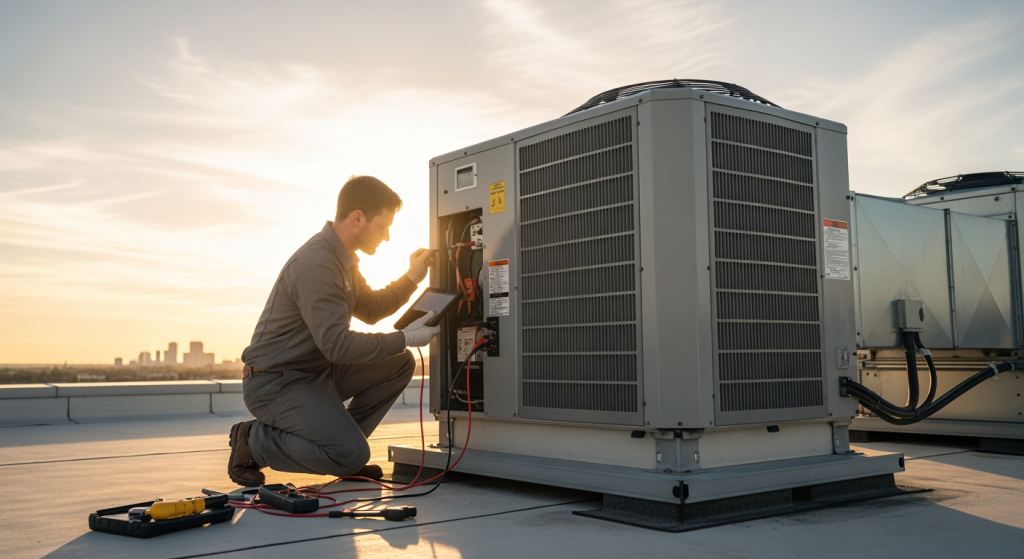
Rooftop units are the workhorses of many commercial buildings, but small problems can compound fast when you’re managing comfort, indoor air quality, and uptime across a facility. This guide breaks down the most common rooftop unit warning signs that suggest your RTU may need professional attention—before those issues turn into downtime, tenant complaints, or product risk. It’s written for facility managers, operations leaders, and business owners who need practical ways to spot trouble early and respond the right way. During the winter months, RTUs can also show stress in heating mode that becomes more obvious when systems transition back to heavier cooling demand.
If you want a deeper foundation on how these systems are built and what components typically fail first, see Understanding Commercial HVAC Systems.
Bottom Line Upfront: RTU Trouble Signals You Shouldn’t Ignore
- Comfort swings (hot/cold spots, slow recovery) often point to airflow, controls, or capacity issues.
- Unusual noises or vibration can indicate failing motors, belts, bearings, or loose components.
- Higher-than-normal energy use may be caused by dirty coils, failing economizers, or refrigerant problems.
- Short cycling (rapid on/off) can accelerate wear and signals a control, airflow, or refrigerant concern.
- Moisture where it shouldn’t be suggests drain, coil, or building pressure problems that can impact IAQ.
How RTU Problems Typically Start (and Why They Escalate)
An RTU is a packaged system: heating, cooling, fans, filtration, and controls all live together on the roof. Because components are interdependent, one “small” issue—like a clogged filter or a drifting sensor—can create downstream problems such as coil icing, compressor stress, or poor ventilation performance.
Many failures don’t begin as a dramatic shutdown. They start as subtle changes: longer run times, inconsistent temperatures, or intermittent alarms. Catching those early usually means fewer operational disruptions and more options for scheduling service around business needs rather than reacting to a breakdown.
The Real Operational Cost of Waiting on RTU Issues
Delaying service can affect more than comfort. In commercial spaces, an underperforming RTU can impact occupant experience, temperature-sensitive areas, humidity control, and even how hard other equipment has to work to compensate.
- Downtime risk: Minor component wear can become a no-cool/no-heat event when demand increases.
- Budget surprises: Running inefficiently can raise utility costs and accelerate wear on compressors, motors, and contactors.
- Indoor air quality concerns: Poor filtration, incorrect outside-air settings, or standing water can create avoidable IAQ complaints.
- Scheduling constraints: When more businesses need service at the same time, lead times for parts and labor can tighten.
7 Rooftop Unit Warning Signs Facility Teams Should Treat as Red Flags
- 1) Hot/cold complaints that weren’t happening before
Why it matters: Comfort swings often indicate airflow restrictions, failing fan components, or control issues.
What to do: Note which zones are affected, when it happens, and whether it correlates with occupancy or weather changes. Confirm thermostats/sensors aren’t obstructed.
Get help when: Complaints persist after basic operational checks or multiple zones show the same pattern. - 2) Short cycling (frequent starts and stops)
Why it matters: Rapid cycling can stress compressors and electrical components and may indicate refrigerant, airflow, or controls problems.
What to do: Capture timestamps of cycles, check for recent setpoint changes, and document any fault codes shown on the controller.
Get help when: Cycling repeats daily, trips safeties, or impacts comfort/temperature stability. - 3) New rattling, grinding, squealing, or excessive vibration
Why it matters: Noises can signal belt wear, bearing failure, loose fan assemblies, or motor issues that can escalate into a shutdown.
What to do: Record a short video/audio clip from a safe location and note whether sound happens on start-up, steady run, or shutdown.
Get help when: Noise increases over time, vibration is visible, or the unit sounds different than other identical RTUs on site. - 4) Energy bills trending up without an operational change
Why it matters: Dirty coils, failed economizer operation, incorrect outside-air settings, or refrigerant issues can drive longer run times and higher demand.
What to do: Compare runtime trends (BAS, controller logs) and note any recent schedule overrides or tenant changes.
Get help when: A single unit’s runtime spikes compared to similar equipment or the building’s baseline shifts unexpectedly. - 5) Water around the unit, ceiling staining, or persistent musty odor
Why it matters: Drain clogs, pan overflow, or coil issues can lead to moisture problems that affect finishes and IAQ.
What to do: Document where moisture appears and whether it’s tied to cooling operation or rain events. Escalate building envelope concerns as needed.
Get help when: Water repeats, staining spreads, or odors persist after housekeeping and basic checks. - 6) Weak airflow at registers or longer time to reach setpoint
Why it matters: Restricted filters, failing fan motors, belt issues, or duct static problems can reduce delivered capacity and strain components.
What to do: Confirm filters are on schedule and correctly installed. Note any recent space reconfigurations that could affect airflow balance.
Get help when: Airflow reduction is noticeable across multiple areas or the unit can’t maintain normal operating conditions. - 7) Recurring alarms, tripped breakers, or intermittent shutdowns
Why it matters: Electrical and control faults can be intermittent before they become permanent failures, especially under higher load.
What to do: Log alarm codes, breaker trips, and the sequence of events. Avoid repeated resets without understanding the cause.
Get help when: Any safety trips recur, the unit fails to restart normally, or electrical issues are suspected.
Smart Moves That Prevent RTU Breakdowns (Without Guesswork)
- Standardize a simple symptom log: Track comfort complaints, noise changes, runtime anomalies, and alarm codes by unit ID.
- Keep access and identification clean: Ensure unit labels, disconnects, and roof access paths are clear for faster diagnostics.
- Align filter and coil care with site conditions: Higher dust, nearby construction, or heavy foot traffic can require tighter intervals.
- Verify schedules and setpoints: Confirm the BAS/controller schedule matches operating hours and isn’t stuck in override.
- Plan service before peak demand: Use shoulder seasons to address wear items (belts, contactors, sensors) and resolve recurring alarms.
- Coordinate multi-site standards: If you manage multiple locations, use consistent PM checklists, naming conventions, and escalation rules.
Professional Insight: The Pattern Behind “Random” RTU Failures
In practice, we often see “sudden” RTU breakdowns that were preceded by small, repeatable signals—short cycling that got normalized, a recurring alarm that was cleared without root-cause correction, or a gradual airflow decline that showed up as comfort complaints first. When those early indicators are documented and acted on, service becomes more predictable and less disruptive to operations.
When It’s Time to Bring in a Commercial HVAC Pro
Seek professional support when any of the following are true:
- The unit trips safeties or breakers more than once or requires repeated resets to run.
- You hear grinding/squealing or see abnormal vibration that suggests mechanical wear.
- Temperature or humidity control affects operations (customer areas, healthcare spaces, food service, or temperature-sensitive storage).
- Alarms repeat after you’ve confirmed schedules and basic operating settings.
- Water intrusion or persistent odors suggest drainage or IAQ-related issues.
For businesses in the Dallas–Fort Worth area, including Denton, TX, it’s also smart to schedule service with enough lead time to avoid avoidable delays when demand increases.
Common Questions Answered
What’s the difference between an RTU issue and a thermostat problem?
A thermostat or sensor issue often shows up as inconsistent readings or a mismatch between actual space conditions and what the controller “thinks” is happening. RTU problems more often include airflow changes, unusual sound, repeated alarms, or inability to maintain conditions even with correct settings.
Is unusual noise always a sign of impending failure?
Not always, but a new or worsening noise is a meaningful indicator. It can be caused by loose hardware, belt wear, or motor/bearing problems. Because some causes escalate quickly, it’s worth documenting and having it evaluated.
Why does my unit run longer even when the weather seems mild?
Longer run times can be driven by dirty coils, reduced airflow, control drift, outside-air/economizer issues, or changes inside the space (occupancy, equipment heat, layout). Runtime changes are a useful early signal to investigate.
What information should I collect before I call for service?
Have the unit ID/location, recent symptoms (comfort, noise, water), any alarm codes, approximate start time of the issue, and whether the problem is constant or intermittent. If you have a BAS, trend data on space temperature and runtime can also help.
How can I reduce repeat visits for the same RTU problem?
Track recurring symptoms by unit and share that history during dispatch. Repeated resets without documenting alarms can hide the pattern. Consistent records help technicians focus on root cause rather than only restoring temporary operation.
Taking Action Before Peak Season Crowds the Schedule
RTUs rarely fail without leaving clues. If you watch for comfort swings, cycling issues, unusual noise, moisture, airflow changes, and recurring alarms, you can address problems earlier—often with less disruption and clearer planning. Build a simple process for logging symptoms, prioritizing critical spaces, and scheduling service before issues stack up. That approach helps protect occupant comfort, equipment life, and operating budgets.
Ready to Get Started?
Our team is here to help. Give us a call to discuss your needs.